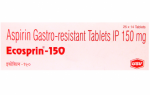







Ascad 150mg Tablet
 Item requires a valid prescription
Manufactured By Micro Labs Ltd
Composition Aspirin (150mg)
Package Size ( 14 Tablet in a strip )

100% Authentic
Products

Free Delivery
COD

Easy Returns &
Cancellation
Pharmacies (5)
MRP Rs 6.02
Sort pharmacies by
Description:
Ascad 150mg Tablet is an antiplatelet drug which is used to prevent clots in blood vessels and also relieves pain and inflammation. It can be taken in combination with other antiplatelets for a better action. It is not recommended in patients with bleeding disorders. Close monitoring of platelets count is necessary.
Uses / Indications:
Prevention of Angina (heart-related chest pain),Treatment and prevention of Heart attack, Treatment and prevention of Stroke
Interactions / Warnings:
It is unsafe to consume alcohol with Ascad 150mg Tablet
Pregnancy interaction:
Expert advice:
Side Effects:
How to use:
How it works:
Faq for medicine:
A: Yes, Ascad acts as a blood thinner. In low doses, it has antiplatelet action and it prevents the platelets from sticking together. This helps to decrease the risk of blood clot formation in blood vessels and provides protection from heart attack and stroke.
Q: Is Ascad an NSAID (non-steroidal anti-inflammatory drug)?
A: Yes, Ascad is a NSAID (non-steroidal anti-inflammatory drug). In low doses, it protects the heart and prevents heart attacks and stroke. In higher doses, it relieves mild to moderate pain, fever, and inflammation and is useful in arthritis, minor body aches, and pains and headache.
Q: Can I take Ascad and clopidogrel together?
A: Yes, you can take Ascad and clopidogrel together. Fixed-dose combinations of clopidogrel and Ascad are available and effectively lowers the risk of heart attack and is used in patients after a coronary artery stent but it can increase the risk of bleeding.
Q: Is Ascad good for a hangover headache?
A: No, Ascad should not be used for alcohol hangover/ hangover headache. Alcohol use cause damage to the stomach lining and use of aspirin along with can increase the risk of stomach bleeding.
Q: Is Ascad beneficial in certain diseases of heart?
A: Yes, at low dose, Ascad is beneficial for patients who are at an increased risk of heart attack and stroke. It is also advised after stent placement or coronary artery bypass. In low doses, it does not allow the platelets to stick together and decreases the risk of blood clot formation.
Q: Can I take Ascad empty stomach?
A: Yes, Ascad can be taken in an empty stomach particularly to increase its rate and extent of absorption, as the presence of food interferes with Ascad absorption. Having said so, aspirin taken in an empty stomach can irritate the stomach surface and cause erosions.
Q: Is Ascad good for hair growth?
A: No, Ascad is not known to play any role in hair growth. It is a NSAID (non-steroidal anti-inflammatory drug). In low doses, it protects the heart and prevents heart attacks and stroke. In higher doses, it relieves mild to moderate pain, fever, and inflammation
Q: Is Ascad safe?
A: Ascad is safe to use in the doses as advised by the doctor, however, there are some common side effects associated with its use like nausea, vomiting, dyspepsia, gastritis, bleeding disorder, decreased blood platelets, gastric erosion, and gastric ulcer.
Q: Can I take Ascad with Tamsulosin?
A: Ascad and Tamsulosin can be taken together. There are no known drug-drug interactions when they are used together.
Q: Can I take Ascad with famotidine?
A: Ascad can be taken with famotidine. Ascad is a pain killer and belongs to the group of NSAIDs (non-steroidal anti-inflammatory agents) which can increase the gastric acid secretion and worsen stomach acidity, heartburn, and stomach ulcers and drugs like Famotidine are used to prevent and treat gastric problems caused by painkillers.
Q: Can I take fexofenadine with Ascad?
A: Yes, you can take fexofenadine with Ascad. Fexofenadine is an anti-histaminic drug used for the treatment of allergic diseases and Ascad is a NSAID (non-steroidal inflammatory drug) and has antiplatelet action and helps to relieve pain, fever, and swelling. There are no reported drug interactions or harmful effects when they are used together.
Q: Are Ascad and ASA (acetylsalicylic acid) the same?
A: Yes, Ascad and ASA (acetylsalicylic acid) are the names for the same medicine. Aspirin is called acetylsalicylic acid, as it is an acetyl derivative of the salicylic acid and is commonly abbreviated as ASA.
Q: Does Ascad cause Hpylori infection?
A: Ascad is not known to cause Helicobacter Pylori infection. However, its use in patients already having H. pylori infection can cause an increased risk of stomach ulcers and bleeding due to these ulcers.
Q: Can I take ibuprofen after Ascad?
A: It is advisable to not take ibuprofen with Ascad. Your doctor can suggest an alternative. Ibuprofen can decrease the antiplatelet effect of Ascad. When taken together, they can cause increased anticoagulation and potassium levels. Also, Ascad can increase the level of ibuprofen. If needed, take ibuprofen 8 hours before Ascad or 2 to 4 hours after.
Q: How and where is Ascad metabolized?
A: After oral intake, Ascad rapidly gets converted to salicylic acid, its major active circulating form. Both are primarily metabolized (broken down) in the liver to salicyluric acid and products like phenolic and acyl glucuronides and others. All metabolites are excreted through the kidneys.
Q: Why is Ascad contraindicated in patients with asthma?
A: Yes, use of Ascad is contraindicated in patients with asthma, rhinitis and nasal polyps. Ascad can cause allergic reactions like urticaria (raised, itchy, skin rashes), angioedema (swelling of skin and tissue under the skin), or bronchospasm (narrowing of the airway).
Q: Is there any interaction between Ascad and vitamin D?
A: No, drug-drug interactions or additional harmful effects have been reported when Ascad and vitamin D are used together.
Q: Is asacol also Ascad?
A: No, asacol is not Ascad. Asacol is 5-aminosalicylic acid and is used in the treatment of ulcerative colitis while Ascad is acetylsalicylic acid (ASA) and belongs to the group of pain killers.
Q: What are the allergic reactions to Ascad?
A: Allergic reactions to Ascad can predominantly affect the respiratory airway tract causing nasal congestion, running nose and difficulty in breathing or the allergic reactions can be limited resulting in urticaria (raised, itchy, skin rashes) and angioedema (swelling of the lower layer of skin and tissue just under the skin).
Q: How is Ascad helpful to prevent stroke?
A: Ascad helps in stopping the processes of platelet adhesion and aggregation (clumping of platelets). Thereby, the risk of formation of blood clots in the vessels supplying the brain is reduced leading to lesser chances of occurrences of stroke.
Q: Is Ascad bad for your liver?
A: No, as such Ascad does not harm your liver. However, if you already have some liver disorder or haven taken Ascad at high doses, there can be occurrence Ascad-related toxicity. Hence, it is necessary to disclose your liver condition to the treating physician.
Q: How does Ascad act as an antiplatelet drug?
A: Ascad blocks the enzyme cyclooxygenase which is necessary for the production of thromboxane. Thromboxane normally acts as a pro-aggregatory agent causing the platelets to clump and form a clot. Hence, Ascad by blocking the action of thromboxane functions as an antiplatelet drug.
Q: Can Ascad make one constipated?
A: Yes, long-term use of Ascad has been associated with constipation. However, occurrence of this side effect is not very common.
Q: Does Ascad really work for acne?
A: Ascad contains acetyl salicylic acid. And salicylic acid is a common component of most of the topical (local application) creams of acne. However, Ascad as such is not used in the management of acne.
Medicine interaction:
Available Substitutes